Trailblazers: Black History Month Biography Passages + Research Project (Grades 4–8)
$5

Nonfiction articles · Grades 4–6 · PDF, 28 pages + PowerPoint · Free
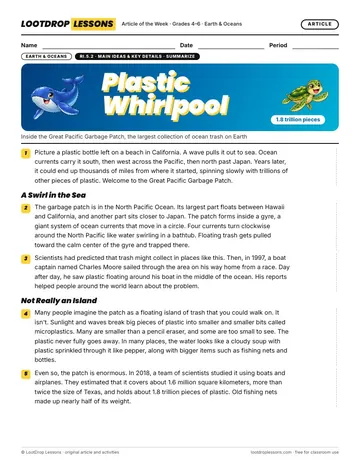
Plastic Whirlpool is a free, complete week of nonfiction reading for grades 4 to 6. Students read an original article about the Great Pacific Garbage Patch: how ocean currents in a gyre trap trash, why the patch is not really an island, how plastic harms sea turtles, seabirds and the whole food web, why cleanup is so hard, and what kids can do to help.
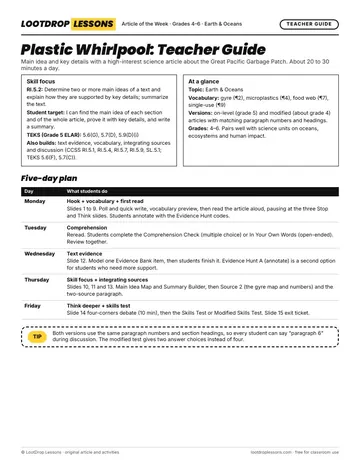
The focus standard is RI.5.2 (main ideas and key details, and summarizing). Clear section headings make it easy for students to find the main idea of each section, prove it with key details, combine those into the main idea of the whole article, and write a strong summary.
The article comes in an on-level version (grade 5) and a modified version (about grade 4) with matching paragraph numbers and headings, so the whole class can discuss the same evidence. A gyre map and real numbers from a 2018 scientific study give students practice integrating sources. Facts were checked against the 2018 Scientific Reports study, NOAA and National Geographic Education.
Topics: staar, test, prep, review, math, intervention, rti, mtss, sped, slides, powerpoint, presentation, elementary, middle, school, grade, 4, 5, 6, free
Built for grades 4–6 (elementary and middle school ELA). Format: PDF, 28 pages + PowerPoint. Free to download. Ways to use it: article of the Week routine; science units on oceans and ecosystems.
Grades 4–6, so it fits elementary and middle school ELA classes.
PDF, 28 pages + PowerPoint. You can edit it to fit your class.
It is free.
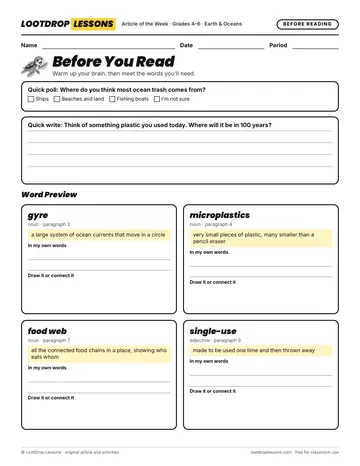
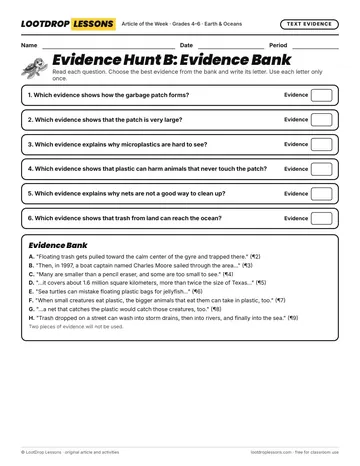
Original article: on-level + modified versions, Teacher guide with a five-day plan (CCSS + TEKS), Before You Read vocabulary preview, Comprehension Check (multiple choice) + In Your Own Words (open-ended), Evidence Hunt A (annotate) + Evidence Bank, RI.5.2 Main Idea Map + Summary Builder, Integrating sources: gyre map + the numbers, Two Sources, One Answer writing task.
Yes, an answer key is included.
Popular ways to use it: Article of the Week routine; Science units on oceans and ecosystems; RI.5.2 instruction and test prep; Small groups and intervention (modified version).