
Teaching the Visualizing Reading Strategy: Mind Movie Activities for 2nd to 5th Grade
 Andy Navarro · Reading Skills & Phonics · · 3 min read
Help students make a movie in their minds as they read. Simple visualizing lessons, sensory-detail activities and ways to check that students are really picturing the text.
Good readers make pictures in their heads without thinking about it. Struggling readers often don't. They decode every word and reach the end of the page with nothing to show for it, because nothing played in their minds while they read.
Visualizing is one of the easiest comprehension strategies to teach and one of the most fun. Here's how I teach it so students actually use it.
Call it a mind movie
"Visualize" is a big word for second graders. "Play the movie in your mind" makes sense to every kid. I tell students that authors are movie directors: they choose words so readers can see, hear, smell, taste and feel the scene. Our job is to press play.
Model it out loud first
Read a short, detail-packed paragraph aloud and stop to describe what you're picturing. "When it says the pancake landed with a soft plop, I can hear it. When it says syrup in a zigzag, I see golden lines across the stack." Point to the exact words that made each picture. Students need to hear that the pictures come from the text, not just their imagination.
Use all five senses
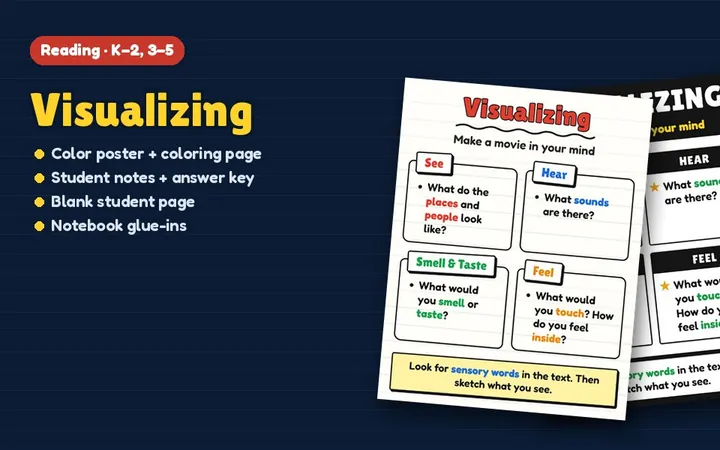
Students often think visualizing only means seeing. Push them to notice every sense:
- See: colors, sizes, shapes, actions
- Hear: voices, sounds, music, silence
- Smell and taste: food, the air, a place
- Feel: temperature, textures, emotions
A simple four-box chart (I see, I hear, I smell or taste, I feel) turns this into something students can show you.
Activities that work
- Close your eyes and listen. Read a scene card aloud while students close their eyes. Then they sketch what they pictured in 2 minutes. Compare a few sketches. They'll all be a little different, and that's the point.
- Sense-word hunt. Students highlight words that helped them picture the scene and sort them by sense.
- Slow-motion storyboard. Read a scene one or two sentences at a time. Students draw three frames, beginning, middle and end, and note what changed. This shows how pictures grow as we read.
- Same scene, different movies. Two partners draw the same paragraph, then explain which words led to their choices. Great for discussion and for noticing details they missed.
- Picture book cover-up. Read a picture book page without showing the illustration. Students sketch it, then reveal the real picture and compare.
Visualizing helps writing, too
Once students notice how authors create pictures, they can do it themselves. After a visualizing lesson, have students rewrite a flat sentence ("The dog was happy") so a reader could see and hear it ("The puppy's tail thumped against the bench, faster and faster"). It's the same skill from the other side.
How to check that students are really visualizing
A sketch alone doesn't tell you much. Ask students to label their drawing with the words from the text that gave them each detail. If a student draws a red sled and the text said red sled, they're visualizing from the text. If the drawing has nothing to do with the words, reread together and talk about what the author wrote.
When to use it during the year
Teach visualizing early in the year with short scenes, then revisit it with poems, which are packed with imagery, and with nonfiction, where visualizing a process (like how a volcano erupts) helps students understand it. It's not a one-week skill. It's a habit.
The resources below include free Mind Movies task cards with eight sensory scenes, a response sheet, a storyboard and a digital version, plus a visualizing anchor chart.
Questions teachers ask
What is the visualizing reading strategy?
Visualizing means creating pictures, sounds and other sensory images in your mind as you read, using the author's words. It helps readers understand and remember the text.
How do you teach visualizing to struggling readers?
Read short, detail-rich passages aloud so decoding isn't a barrier, model your own mental pictures, and have students sketch and label what they picture with words from the text.
Is visualizing only about seeing?
No. Strong visualizers use all five senses: what they see, hear, smell, taste and feel in a scene.



Comments
Questions, tweaks that worked in your room, ideas for other teachers: share them here.
Loading comments...