
Teaching Money in Kindergarten, 1st and 2nd Grade: Coin Activities That Make It Stick
 Andy Navarro · Elementary Math · · 4 min read · Updated
How to teach coins and counting money in K–2: identifying coins, skip counting, counting mixed coins, a class store and games.
Money is one of the most real-world things young students learn in math, and it's also one of the trickiest. A dime is smaller than a penny but worth more. A nickel is bigger than a dime but worth less. Kids have to stop judging coins by size and start thinking in fives, tens and twenty-fives. That takes time, a lot of hands-on practice and a clear progression.
Here's how I'd sequence money from kindergarten through second grade, with activities for each step.
What students learn in each grade
- Kindergarten: identify the coins by name and appearance. Many standards, including Texas TEKS, include coin identification here.
- 1st grade: know the value of each coin and start counting collections of the same coin by skip counting.
- 2nd grade: count mixed collections of coins up to a dollar, use the ¢ and $ symbols, and solve word problems with money. In the Common Core, this is standard 2.MD.C.8. In Texas, it's TEKS 2.5A and 2.5B.
Check your own standards, but that progression holds in most places.
Step 1: Know the coins
Start with real coins whenever you can, or good realistic plastic ones. Students should see and touch both sides.
- Penny: 1 cent, copper color, Abraham Lincoln on the front.
- Nickel: 5 cents, silver color, Thomas Jefferson on the front, smooth edge.
- Dime: 10 cents, silver, the smallest coin, Franklin D. Roosevelt on the front, ridged edge.
- Quarter: 25 cents, silver, the biggest of the four, George Washington on the front, ridged edge.
One note for 2026: the U.S. Mint stopped making new pennies for circulation in 2025, but pennies are still legal money and still part of the standards. Students may see fewer of them, so it's worth explaining why.
Coin songs and chants help a lot here. So does a "mystery coin" bag: a student reaches in, feels a coin without looking and describes it (smooth or bumpy edge, big or small) before guessing.
Step 2: Sort and match
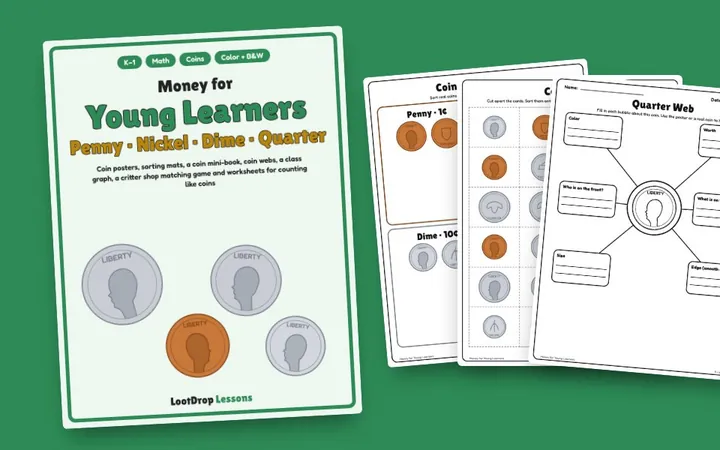
Sorting builds the habit of looking closely. Give each student a mix of coins and a sorting mat. Then have them match coins to cards showing the name, the value and the picture. A coin web is another good one: put a coin in the middle, and students fill in the name, value, color, size and who is on it.
Step 3: Count the same coins
Connect money to skip counting, which students already know: pennies count by ones, nickels by fives, dimes by tens. Line up four dimes and count together: 10, 20, 30, 40 cents. Quarters (25, 50, 75, 100) are harder, so practice them on their own before mixing them in.
Step 4: Count mixed coins
This is the big jump in second grade. Teach students to:
- Sort the coins from greatest value to least.
- Start with the biggest value and count on: quarter, 25; dime, 35; dime, 45; nickel, 50; penny, 51.
- Touch each coin as they count so they don't skip or double count.
The "count on" switch is where students get stuck. Practice it on a number line or hundred chart first, so they can see the jumps change from 10 to 5 to 1.
Step 5: Use it in real situations
A class store
This is the best money activity there is. Price small items or picture cards (an eraser for 15¢, a sticker for 32¢) and give students a coin purse. Shoppers pick an item and count out the right amount. The cashier checks it. Rotate jobs so everyone gets to do both.
Show it two ways
Give students an amount, like 30¢, and ask them to show it two different ways with coins. Three dimes works. So do a quarter and a nickel, or six nickels. This builds flexible thinking and is a great challenge for early finishers.
Money word problems
"Mia has 2 dimes and 3 pennies. Does she have enough to buy a 25¢ pencil?" Word problems like this combine counting money with comparing and solving, which is exactly what tests ask for.
Games
Race to a dollar is a simple partner game: roll a die and collect that many pennies, trading 5 pennies for a nickel, 2 nickels for a dime and so on. The first player to trade up to a dollar wins. Students learn trading and equivalence without realizing it.
Tips that help
- Use real or realistic coins as long as possible before switching to pictures.
- Keep a coin poster up all unit, showing both sides of each coin and its value.
- Send a note home asking families to let kids count change at the store. It's the best homework there is.
Questions teachers ask
What grade do students learn to count money?
Students usually learn to identify coins in kindergarten, count coins of the same kind in 1st grade and count mixed coins and solve money problems in 2nd grade, though standards vary by state.
What is the best order to teach coins?
Teach coin names and values first, then sorting and matching, then counting the same coins, then counting mixed coins starting with the largest value.
How do you make money activities hands-on?
Use real or play coins, set up a classroom store and solve real-life problems like buying a snack. Handling coins makes values easier to remember.
For K–1, Money for Young Learners has coin posters, sorting mats, a My Book About Coins mini book, coin webs, games and worksheets. For second grade, Cash Quest is a full unit with five lesson plans, worksheets, two games and a ready-to-run class store. Both are below.



Comments
Questions, tweaks that worked in your room, ideas for other teachers: share them here.
Loading comments...