
Lord of the Flies Pre-Reading Activities: A Launch Week That Sets Up the Novel
 Andy Navarro · Short Stories & Literature · · 3 min read
Lord of the Flies pre-reading activities for grades 8–12: a rules jigsaw, an island charter, a good vs. evil debate and the context students need before chapter 1.
Lord of the Flies lives or dies in the first week. If students open chapter one cold, they get a slow start, unfamiliar British slang and a group of boys they can't tell apart. If they open it already arguing about whether people need rules, they read to find out who was right.
These pre-reading activities take about five days. By the time Ralph blows the conch, your students will have written their own rules, defended a position on human nature, and started predicting how it all falls apart.
What students need before chapter 1
- The big question. Are people basically good, and corrupted by society? Or basically selfish, and held in check by rules? The novel is William Golding's answer.
- A little context. Golding published the novel in 1954, after serving in the Royal Navy in World War II. He had also been a schoolteacher. He knew boys and he had seen war.
- The setup. A plane carrying British schoolboys crashes on an island during a war. No adults survive.
- Key terms. Civilization, savagery, allegory, symbol. Define them now and you can use them all unit.
Day 1: Why do we have rules?
Start with a quick write: "Name one rule you follow that you think is pointless, and one you'd keep even if no one enforced it." Then run a jigsaw on codes of conduct through history. Groups each take a short excerpt, such as Hammurabi's code, the Ten Commandments, a section of the Bill of Rights or your own school handbook, and report: who made it, who it protects, and what happens if it is broken.
Day 2: Write the island charter
Put students in groups of five. They are stranded with no adults. They have twenty minutes to agree on a leader, five laws and a consequence for breaking them. Watch what happens. Some groups vote, some get taken over, one always argues about who decides. Debrief on the process, not just the product: How did you choose a leader? Whose ideas were ignored?
Keep the charters. In chapter two, students compare theirs to what the boys set up, and in chapter eight they look at what is left of it.
Day 3: Good or evil?
Run a four-corners debate with statements such as "People are naturally good," "Without rules, most people would do what they want," and "Fear makes people cruel." Students move, defend a position, and may switch if persuaded. Then give them two short philosophical views in plain language: one that people are good and society corrupts them, one that life without authority would be brutal. Students decide which view the charter activity supported.
Day 4: A survival scenario
Read a short survival story or a nonfiction account of a real group stranded together. Ask what kept people working together and what broke them apart. Real cases often show cooperation, which makes a good counterpoint to Golding's view later.
Day 5: Set up the reading
- Character tracker. A page for Ralph, Jack, Piggy, Simon and Roger, started on day one of reading. Telling the boys apart early is half the battle.
- Symbol watch list. The conch, Piggy's glasses, the fire, the beast. Don't explain them. Just tell students to watch.
- A prediction. Based on your charter group, how long will the boys' rules last? Seal it in an envelope.
Questions teachers ask
What grade is Lord of the Flies taught in?
Usually grades 9 or 10, and sometimes 8th in advanced classes.
What should students know before reading?
The central question about human nature, the wartime setting, and the terms allegory and symbol.
How long should pre-reading take?
Three to five days. A full week pays for itself in how students read the first four chapters.
Does this work for other novels?
Yes. The same launch fits any survival or society novel, including Hatchet, The Maze Runner and most dystopian fiction.
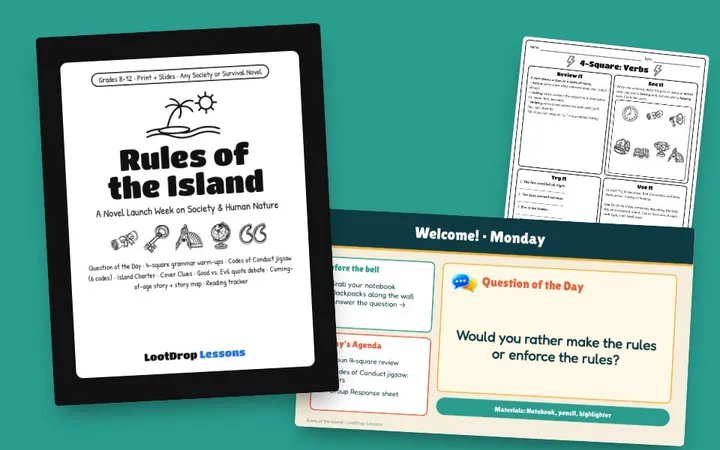
If you want the week planned, Rules of the Island is a five-day launch for Lord of the Flies or any survival novel, with the codes of conduct jigsaw, the Island Charter, a good vs. evil debate and a coming-of-age story. For the genre side, see the dystopian unit plan for any novel.




Comments
Questions, tweaks that worked in your room, ideas for other teachers: share them here.
Loading comments...